Why Intersectionality Training Belongs in Every Workplace and How to Deliver It Meaningfully
What is Intersectionality, and Why Does it Matter at Work?
- Women of colour receive fewer promotions from entry-level to manager than men or white women (McKinsey & Company, LeanIn.Org, 2025)
- A Canadian study found that gay, lesbian, and bisexual workers are more likely to have low-quality jobs and precarious employment compared to straight workers (SSM – Population Health, 2023)
- Roughly 1 in 3 women with disabilities and 1 in 4 LGBTQ+ and Black women have felt invisible or like their accomplishments didn’t get noticed at work (McKinsey & Company, LeanIn.Org, 2023)
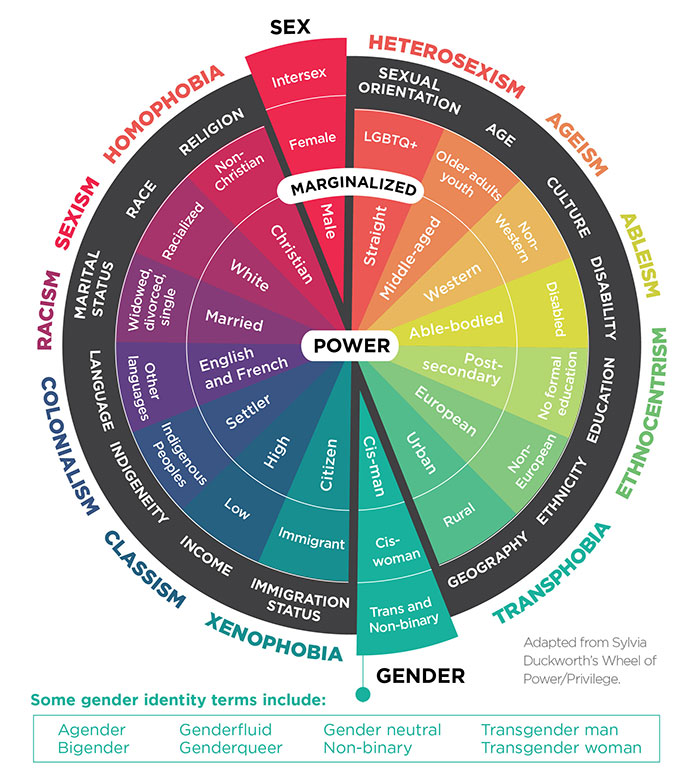
From: Dr. Greta Bauer’s Power Wheel (Canadian Institutes of Health Research, 2021)
The Pride Month Connection: Addressing Intersectionality & Layered Identigites
Pride Month celebrates 2SLGBTQ+ identity, and rightly so. But it is also a moment to recognize that 2SLGBTQ+ employees rarely experience their identity in isolation. A transgender woman of colour, a bisexual employee with a disability, a queer person from a low-income background: each navigates a workplace shaped by multiple, intersecting aspects of who they are.
The data reflects this reality. Nearly a third of 2SLGBTQ+ workers have considered leaving, or left, a job because the workplace was not accepting, according to data from the Human Rights Campaign Foundation. That number rises further when intersecting identities are factored in.
The Government of Canada’s 2SLGBTQIA+ Action Plan Survey found that 27% of respondents identified as persons with a disability. Those with intersecting identities were significantly less likely to feel comfortable disclosing their sexual orientation or gender identity at work, more likely to experience harassment, and more likely to face safety concerns related to how they dress or present themselves.
This is what intersectionality training addresses. It is a sustained commitment to understanding how identity shapes every employee’s experience: from the moment they apply, to how they are treated, evaluated, and given opportunities to grow.
The Difference Between Awareness and Action
Pride Month programming that begins and ends with awareness activities, such as a panel discussion, a newsletter, or a flag in the lobby, is not the same as building organizational capacity to respond to intersectional needs. As the World Economic Forum’s DEI Lighthouses 2025 report notes, leading organizations are shifting from attitudinal training toward systemic change: equitable hiring processes, pay equity reviews, and policies that account for complexity rather than compliance.
Meaningful training is the bridge between intention and that kind of change. It gives people at every level the language, empathy, and practical skills to contribute to a more equitable workplace.
Core Content: What an Intersectionality Training Course Covers
Effective intersectionality training is not a slide deck of definitions. Participants need to build genuine understanding, examine their own identities and biases, and leave with tools they can apply in real situations.
Velsoft’s Intersectionality in the Workplace courseware is built around this principle. Here is a what a comprehensive program addresses:
Foundational Knowledge: Identity and Key Terms
| Term | What it means (definition) |
| Intersectionality | How overlapping identities create unique experiences of privilege or oppression. |
| Social Construct | A norm or belief fabricated and accepted by society, often rooted in historical power structures. |
| Sex vs. Gender | The distinction between biological designation at birth and how someone identifies socially and culturally. |
| 2SLGBTQ+ | An acronym recognizing Two-Spirit, lesbian, gay, bisexual, transgender, queer identities and more. |
| Ableism | Institutional discrimination against disabled individuals, including exclusionary language and lack of accommodations. |
| Privilege | Unearned systemic advantages tied to specific aspects of a person’s dominant identity. |
Personal Reflection: The Identity Flower
One of the most powerful elements of intersectionality training is structured self-reflection. Velsoft’s courseware uses an activity called the Identity Flower, in which participants map their own identity across dimensions such as race, gender, sexuality, class, and ability. They then identify which groups hold dominant social power in each category. This exercise is intentionally uncomfortable. It surfaces the ways in which individuals may hold privilege in some areas while facing disadvantage in others, helping participants understand how those combinations shape lived experience.

Understanding Privilege and How to Use It
Privilege often generates defensiveness, but well-facilitated training reframes it as an opportunity. Velsoft’s Intersectionality training in the Workplace course draws on concrete examples, such as a public figure redirecting recognition toward colleagues whose achievements are routinely overlooked, and a colleague tying their own compensation to a peer’s to close a pay gap they had the leverage to address. These examples make an abstract concept tangible. Privilege is not something to feel ashamed of; it is something that can be used intentionally to uplift others.
Everyday and Professional Intersectional Practices
Awareness without application has limited value. Intersectionality in the Workplace moves participants from understanding to action, covering practices such as:
- Reflection: pausing to examine how personal biases shape reactions and judgments
- Universal design: building spaces, documents, and processes accessible to all from the outset
- Diverse knowledge sources: seeking input from people at all levels before making decisions
- Policy review: examining workplace policies through an intersectional lens every two to three years
- Accountability: owning words and actions, and modelling constructive responses when mistakes are made
This content is informed by frameworks including the UN Women Intersectionality Resource Guide and Toolkit, which provides a global standard for applying intersectional thinking in organizational settings.
Workplace Assessment and Continuous Improvement
The final component helps participants evaluate and improve their own organizations, examining culture, policies, and programs through legal, financial, and quality-of-life lenses, and building a plan for ongoing review.
The financial case for intersectional workplaces is real. Organizations that invest in inclusion see measurable improvements in absenteeism, turnover, and workplace grievance claims. The cost of inaction is consistently higher than the cost of the training.
How to Deliver Intersectionality Training That Actually Works
Creating Psychological Safety First
Before participants can engage honestly with topics like privilege and identity, they need to feel safe doing so. This means establishing ground rules at the outset that are agreed upon by the group. Common principles include:
- What is shared in the room stays in the room.
- Disagreement is welcome; disrespect is not.
- Everyone participates to the extent they are comfortable.
- This is a space where it is safe to make mistakes and learn from them.
For 2SLGBTQ+ employees in particular, psychological safety is directly tied to whether they can bring their full selves to work.
Facilitating Difficult Conversations
Intersectionality training will prompt emotional responses. A participant may feel defensive about privilege. Another may feel exposed discussing their identity. A third may push back on concepts like systemic racism or ableism. Skilled facilitators work with these moments rather than shutting them down. Here are some practical approaches:
- Pause when tensions rise, rather than pushing through.
- Redirect from guilt to curiosity. The goal is not for privileged participants to feel ashamed, but to become more aware and intentional.
- Use structured activities to move from abstract debate to personal experience.
- Model accountability by acknowledging your own learning edges as a facilitator.
The course materials include a Trainer’s Tip specifically for moments when participants react defensively to content on privilege.
Beyond Pride Month: Building a Sustained Intersectional Culture
A single training session will not transform an organization’s culture, but it is a meaningful first step. The organizations that treat it as such, rather than a one-time event, are the ones that see lasting change.
The World Economic Forum’s DEI Lighthouses research is clear: impact is sustained when inclusion is integrated into key processes, not treated as a standalone initiative. That means revisiting policies regularly, gathering qualitative data from employees at all levels, and creating systems where concerns can be raised and acted upon.
What Sustaining the Work Looks Like
Training providers can support their client organizations in building this longer-term approach by helping them think through:
- Policy review cycles, such as intersectional policies revisited every two to three years or when a significant gap is identified.
- Qualitative check-ins, including conversations and peer feedback systems that capture how employees actually feel.
- Legal compliance monitoring, including human rights legislation, occupational health and safety requirements, and harassment laws as all intersect with intersectional practice.
- Visible leadership commitment, acknowledging that leaders who model intersectional awareness signal to the entire organization that this is a genuine priority
The goal is progress.
“Intersectionality has made an important contribution to social and political analysis, asking all of us to think about what assumptions of race and class we make when we speak about ‘women’ or what assumptions of gender and race we make when we speak about ‘class.'” — Judith Butler, feminist philosopher
Deliver Meaningful Intersectionality Training This Pride Month. For Free!
This Pride Month, Velsoft is offering its complete Intersectionality in the Workplace training kit at no cost. It is a fully developed, ready-to-deliver package that gives training providers and organizations something genuinely meaningful to offer.
- Instructor Guide: facilitation notes, activity instructions, discussion prompts, and trainer tips
- Participant Manual: workbook with space for notes, an action plan, and an evaluation form
- PowerPoint Slides: presentation materials aligned with each session
- Handouts: including the Identity Flower activity, In Someone Else’s Shoes worksheets, and pre/post-course assessments
- Quick Reference Guide: a two-page summary for participants to keep
- Advertorial: a customizable flyer to promote the training internally
Ready to deliver training that matters? Download the free Intersectionality in the Workplace training kit from Velsoft and give your learners the tools to build workplaces where everyone belongs.