This article is written by Kevin Henderson, Chief Learning Officer at Velsoft and the designer of the Adaptive Paradox Leadership™ framework course. This is the fourth article in his 6-part series on leading through paradox in today’s complex organizations.
This is the fourth article in my Adaptive Paradox Leadership™ series, where I explore Theory U™ Leadership and how leaders navigate competing demands without defaulting to oversimplified solutions. Even with a strong paradox mindset and tools like the Tension Compass™, leaders can still rush ahead too quickly.
In complex environments, speed often feels like competence. But experience shows that slowing down at the right moment enables better leadership decision‑making.
A Leadership Lesson from Mozambique
During an international leadership development project in Mozambique, I saw how easily well‑intentioned leaders fall into the trap of speed. The urgency to roll out training programs pushed the team toward quick decisions and standardized solutions.
However, when we intentionally paused and listened to local educators, a different reality emerged. Cultural context, community dynamics, and lived experience had to shape the program design.
That pause changed everything.
Without it, we would have delivered a system that looked efficient but failed in practice.
Instead, we co‑created an approach that was adaptive, culturally grounded, and sustainable. The result was not slower progress—but better progress.
Theory U™: Why Slowing Down Strengthens Leadership Decisions
This experience reflects the core of Theory U™ Leadership, developed by Otto Scharmer (2009, 2016). Theory U™ describes a U‑shaped leadership journey that helps leaders move beyond habitual reactions toward more conscious and adaptive action.
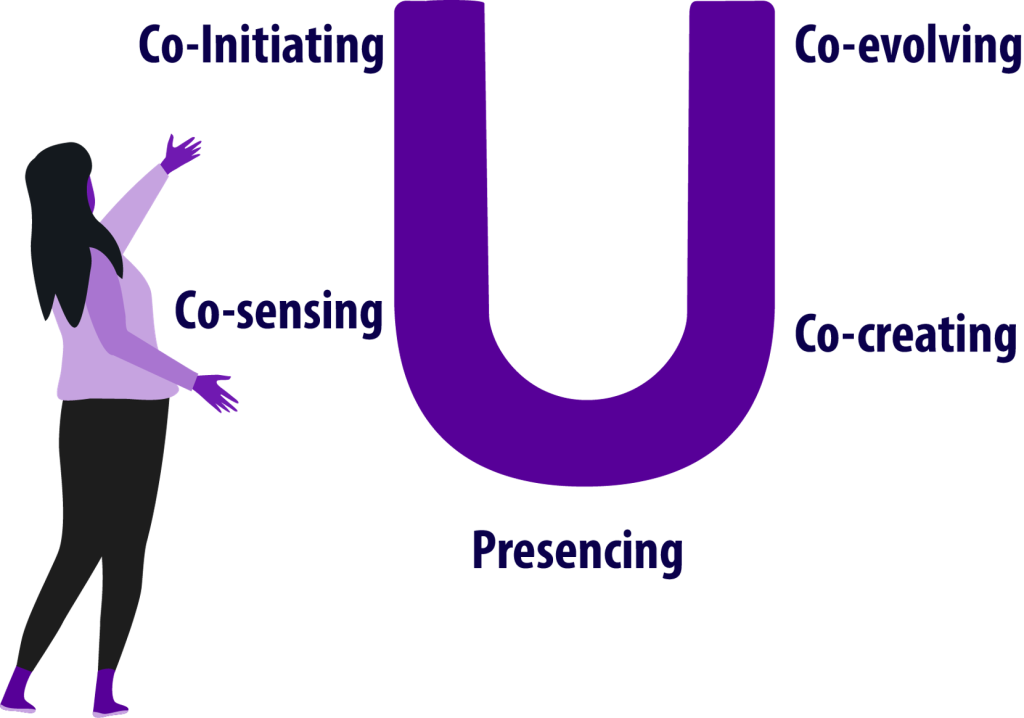
The process includes:
- Co‑initiating – building shared intention
- Co‑sensing – deeply observing and listening
- Presencing™ – pausing to connect with deeper insight
- Co‑creating – taking action through experimentation
- Co‑evolving – embedding learning for long‑term impact
The most overlooked step is presencing™—the pause at the bottom of the U. This is not wasted time. It is where leaders:
- Suspend judgment
- Let go of assumptions
- Open their minds and hearts
- Sense emerging possibilities before acting
In high-pressure, fast environments, the leadership pause can feel uncomfortable. Yet it is often the difference between reactive leadership and transformational leadership.
Reflection Prompt for Adaptive Leaders
Before your next decision, take a moment to pause and reflect:
- What judgments or assumptions might you need to let go of?
- What subtle signals or perspectives are you usually overlooking?
- What possibility feels like it’s waiting to take shape if you slow down?
Jot down one sentence.
Example:
“If we slowed the rollout, we could involve staff earlier and reduce resistance.”
What’s Next in the Adaptive Paradox Leadership™ Series?
Sensing is powerful, but leadership also requires action.
In the next post, I’ll explore Herminia Ibarra’s concept of Act Like a Leader, Think Like a Leader and how small experiments help leaders learn forward while navigating uncertainty and paradox in complex systems.
Want To Go Deeper?
If Theory U™ leadership and the power of the pause resonated with you, you can explore how these ideas translate into practical leadership skills.
Download a free sample of the Adaptive Paradox Leadership™ course to:
- Learn to lead effectively in VUCA and complex environments
- Develop a paradox mindset to navigate competing demands
- Apply practical tools like the Tension Compass™, Theory U™, and small leadership experiments
- Build a personal action plan grounded in real-world case studies
No commitment or credit card required.